Why Strength Matters More Than Many People Realize
Strength is often associated only with lifting weights or building large muscles, but real strength is much broader than that. It affects how you stand, walk, lift, balance, sit, and move through daily life. Strength helps protect the joints, supports posture, improves stability, and makes the body more resilient. In simple terms, strength is what allows the body to do work safely and efficiently. For example, carrying shopping bags, climbing stairs, getting up from the floor, or holding good posture at a desk all require strength. Yoga becomes especially valuable here because it builds usable strength rather than strength that exists only in isolated exercises.
What Makes Yoga a Different Kind of Strength Training
Yoga builds strength in a different way from many gym-based workouts. Instead of relying mainly on external weights, yoga often uses body weight, position, control, and time under tension. This means the body learns how to support itself through coordinated movement and steady holding. A useful example is the difference between owning powerful machinery and knowing how to control it well. Yoga does not only ask the body to produce force; it asks it to produce force with balance, awareness, and precision. That is why yoga strength often feels more integrated and more functional.
Why Yoga Builds Both Strength and Control
One of the most important features of yoga is that it develops strength together with control. In many poses, the goal is not just to “hold on” but to remain stable, breathe steadily, and keep proper alignment. This creates a deeper type of strength. It is not only about whether the muscles can work, but whether they can work intelligently. Imagine two people carrying a box. One lifts it with poor posture and strain, while the other lifts it with good positioning and calm effort. Both use strength, but one uses it more skillfully. Yoga teaches that skillful version.
Why Bodyweight Strength Can Be So Powerful
Many people underestimate bodyweight training because there are no dumbbells or machines involved. But the body itself can be a highly effective training tool. In yoga, supporting your own body weight in poses such as Plank, Chair Pose, or Warrior II creates real muscular demand. These poses may look simple at first, but they activate multiple muscle groups at once. Think of it like moving furniture in your own home rather than lifting a barbell in a gym. The effort is still real, and often even more practical because it involves coordination, balance, and endurance at the same time.
Why Yoga Strength Is Functional Strength
At a more advanced level, yoga is valuable because it tends to build what is often called functional strength. This means strength that transfers well into real-life movement. Instead of isolating one muscle at a time, yoga usually trains chains of muscles working together. The shoulders, core, legs, hips, and back often cooperate in one pose. This reflects how the body actually works in life. Rarely do we move one muscle in total isolation. We move as a system. Yoga respects that fact, which is why the strength it builds often feels useful outside the studio.
Why Strength in Yoga Is Not Just About the Arms
When people think of yoga and strength, they often imagine arm balances or difficult poses that look impressive. But yoga strength is not limited to the upper body. In fact, many yoga poses build significant strength in the legs, core, back, hips, and feet. A pose like Chair Pose can challenge the thighs intensely, while Warrior poses build power and endurance in the legs and glutes. Core strength appears in many poses, even when it is not obvious. A simple way to understand this is to think of the body like a building. Strong walls matter, but so do the foundation, beams, and support structures. Yoga trains the whole building.
Why Beginners Can Build Real Strength with Yoga
Some beginners assume yoga is only about stretching and relaxation, but that is a misunderstanding. Yoga can be a serious strength-building practice, especially when poses are held with proper alignment and attention. Beginners do not need advanced poses to become stronger. Even simple postures can create meaningful improvement when practiced consistently. For example, someone who holds Plank for twenty seconds with good form is already building strength. Over time, those small efforts add up. Yoga shows that progress does not always need to begin with dramatic difficulty.
Why Holding a Pose Builds Strength
Holding a pose creates muscular engagement over time, which challenges the body differently from quick movement. This type of effort can build endurance and control as well as strength. In yoga, you are often asked to stay steady while breathing, which makes the work more demanding than it first appears. For example, Chair Pose may look like “just sitting in the air,” but after a short time the legs begin to work hard. That is because stillness removes momentum and reveals actual muscular effort. The body cannot rely on speed. It has to rely on strength.
Why Breath Matters in Strength-Building Yoga
Breathing is just as important in strength-focused yoga as it is in flexibility work. Many people tense up and hold their breath when something feels challenging, but this usually makes effort less efficient. Steady breathing helps distribute tension more intelligently and keeps the nervous system more regulated. A simple example is carrying something heavy while breathing smoothly versus clenching everything and barely breathing. The first method is usually more sustainable. In yoga, breath is part of strength because it helps the body stay organized under effort.
Why Alignment Protects Strength
Strength without alignment can easily become strain. That is why yoga places such importance on how a pose is done, not just whether it is completed. Proper alignment helps direct effort into the right areas and reduces unnecessary stress on the joints. For instance, in Plank Pose, if the hips sag too low or lift too high, the body may avoid useful core engagement and place more pressure elsewhere. In a lunge, poor knee tracking can create discomfort rather than strength. Yoga teaches that strong movement should also be safe movement.
Pose One: Plank Pose for Full-Body Strength
Plank Pose is one of the best yoga poses for building overall strength because it activates the core, shoulders, chest, arms, and legs all at once. Although it looks simple, it requires the whole body to work together. For beginners, Plank teaches how to create one strong line from head to heels. It is similar to holding a bridge steady rather than letting it collapse in the middle. Even a short hold can be effective when the form is good. Over time, this pose builds the kind of strength that supports many other yoga movements.
Pose Two: Chair Pose for Leg and Core Power
Chair Pose is one of the most effective yoga postures for building lower-body strength. It targets the thighs, glutes, and core while also encouraging upright posture and body awareness. In the pose, it feels as though you are sitting into an invisible chair. That image helps beginners understand the action. The legs quickly begin to work, which shows how much strength can be developed with bodyweight alone. Chair Pose also teaches mental steadiness because staying in it calmly is often harder than it looks.
Pose Three: Warrior I for Stability and Strength
Warrior I is a powerful pose for building strength in the legs, hips, and core while also opening the chest and shoulders. It teaches grounded effort. The front leg works strongly, the back leg supports the posture, and the upper body lifts with intention. This creates a balanced feeling of rootedness and upward energy. A simple example is standing firmly while reaching for something overhead. The lower body stabilizes so the upper body can act. Warrior I turns that practical principle into structured training.
Pose Four: Warrior II for Endurance and Control
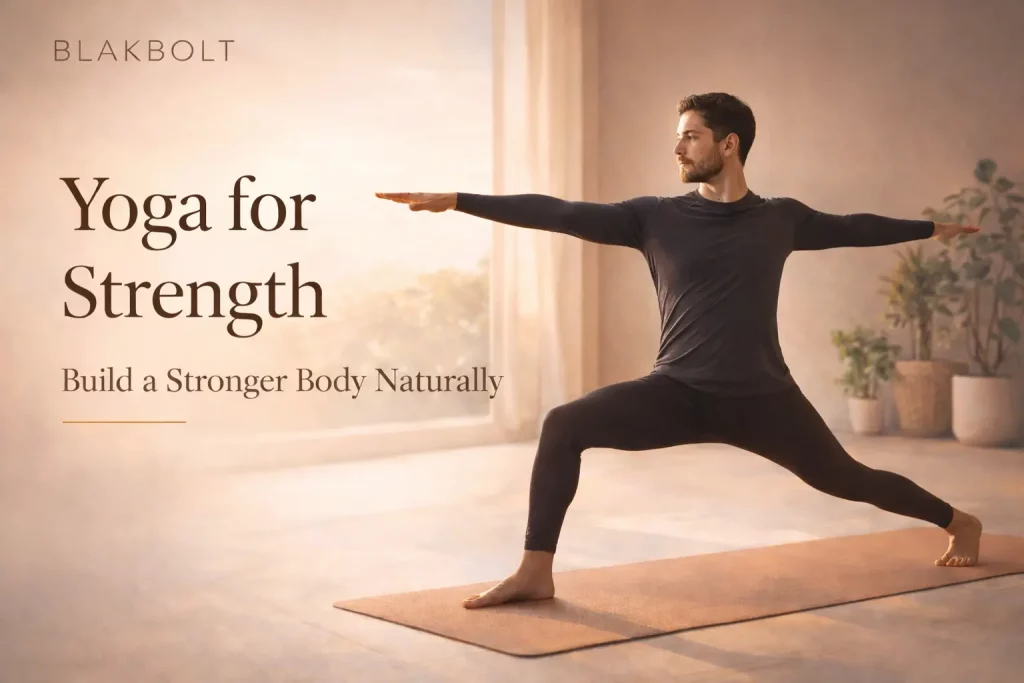
Warrior II is one of the most recognized yoga poses for a reason. It builds strength in the thighs, hips, and shoulders while also improving balance and mental focus. Holding Warrior II for several breaths can be surprisingly demanding, especially in the legs. It teaches endurance rather than only quick effort. Imagine standing in a strong, ready position without collapsing or rushing. That is the quality Warrior II develops. It is not only a physical pose but also a lesson in staying steady under challenge.
Pose Five: Chaturanga Preparation for Upper-Body Strength
Chaturanga and its beginner-friendly variations are excellent for building strength in the arms, shoulders, chest, and core. For many beginners, the full pose is too demanding at first, which is completely normal. A modified version using the knees or lowering only partway can still build meaningful strength. This is important because yoga values progression. Just as a beginner in strength training may not start with the heaviest weight, a beginner in yoga does not need the most advanced variation. The key is controlled effort, not ego.
Pose Six: Boat Pose for Core Strength
Boat Pose is one of the most direct ways yoga builds core strength. In this pose, the abdominal muscles, hip flexors, and back all work to stabilize the body. Beginners may bend the knees or hold the backs of the thighs, which still makes the pose effective. Boat Pose teaches the core to support the spine and pelvis more actively. A strong core matters not only for yoga but for posture, balance, and many daily movements. You can think of the core as the central support column of the body. When it becomes stronger, many other movements improve as well.
Pose Seven: Bridge Pose for the Back Body
Strength is not only built in the front of the body. The back body also needs attention, especially because modern life often weakens the glutes and back while tightening the hips. Bridge Pose helps strengthen the glutes, hamstrings, and back while opening the front of the hips and chest. This makes it especially useful for people who sit a lot. A practical example is someone whose body spends most of the day folded forward over a desk. Bridge Pose helps reverse that pattern by strengthening the muscles that support a more open posture.
Pose Eight: Downward-Facing Dog for Strength and Support
Downward-Facing Dog is often thought of as a stretch, but it is also a strength pose. The shoulders, arms, upper back, and core all work to support the posture, while the legs remain active as well. For beginners, this pose builds endurance in the upper body and teaches how to distribute weight more evenly. It is a good example of how yoga rarely separates strength and flexibility completely. Many poses do both at once. That is part of what makes yoga so efficient.
Why Slow Progress Is Still Real Progress
Strength developed through yoga often grows quietly. You may not notice dramatic changes in a single week, but over time the body feels more stable, supported, and capable. A pose that once felt impossible may become manageable. A hold that lasted ten seconds may later feel comfortable for thirty. This kind of progress matters greatly. It is similar to saving money little by little. The growth may seem small at first, but it becomes significant through consistency. Yoga teaches respect for gradual improvement.
Common Mistakes People Make When Using Yoga for Strength
One common mistake is focusing too much on advanced-looking poses instead of mastering the fundamentals. Another is sacrificing alignment in order to hold a pose longer. A third is forgetting to breathe during difficult moments. These mistakes can reduce the benefits of the practice and increase the chance of strain. Yoga for strength works best when the practitioner chooses form over performance. It is better to do a simple pose well than a difficult pose badly. That principle applies to almost every kind of training.
Why Strength and Flexibility Should Grow Together
At a deeper level, yoga is especially powerful because it does not usually train strength in isolation. It often develops strength and flexibility together. This balance matters because a body that is strong but very rigid may move poorly, while a body that is flexible but unstable may lack support. Yoga helps create a middle path. It encourages strength with mobility, effort with awareness, and intensity with control. In this sense, yoga reflects intelligent physical development rather than one-sided training.
A Simple Yoga Routine for Strength
A simple yoga routine for strength could include Plank Pose, Chair Pose, Warrior I, Warrior II, a modified Chaturanga practice, Boat Pose, Bridge Pose, and Downward-Facing Dog. Holding each pose for a few steady breaths can already create a strong training effect, especially for beginners. This kind of sequence works because it targets the core, upper body, lower body, and back body without becoming unnecessarily complicated. It is practical, balanced, and realistic for regular use.
Example of How Yoga Strength Helps in Daily Life
Imagine someone who feels tired when climbing stairs, struggles with posture at a desk, and notices weakness when lifting ordinary household items. They begin doing a short yoga strength routine three times a week. After a few weeks, they find that standing feels more upright, carrying things feels easier, and they can hold themselves with more confidence. This is how yoga strength shows up in real life. It is not just about what happens on the mat. It is about moving through the day with more support and less effort.
The Deeper Lesson Behind Strength in Yoga
Yoga for strength teaches more than muscle development. It teaches patience, consistency, control, and the ability to stay calm under effort. These are valuable lessons both on and off the mat. Strength in yoga is not only about force. It is about intelligent effort. It is about learning how to engage without overstraining, how to persist without panic, and how to become more capable through disciplined practice. In this way, yoga strength becomes both physical and mental.
Conclusion: Building a Stronger Body Naturally with Yoga
Yoga for strength is a powerful and natural way to build a stronger body. It improves muscular endurance, stability, posture, balance, and control while using the body itself as the main training tool. The best part is that it does not require extreme poses or gym equipment to be effective. With regular practice, simple poses such as Plank, Chair, Warrior, Boat, and Bridge can create real strength that supports everyday life. The true value of yoga for strength is not only that it makes the body stronger, but that it makes strength more balanced, more functional, and more sustainable.